Artificial Lungs Ventilation Machines: Practical Integration in Medical and Design Workflows
Artificial Lungs Ventilation Machines play a critical role in both medical treatment and visual communication. In healthcare, these devices support or replace natural lung function for patients with severe respiratory conditions. In design, especially in the context of web and infographic development, the Artificial Lungs Ventilation Machines icon serves as a clear, monochrome visual representation for medical and emergency-related content. Whether you're a clinician, educator, or digital creator, understanding how to effectively integrate these tools—both mechanical and visual—into your workflow can improve clarity, efficiency, and outcomes.
Understanding Artificial Lungs Ventilation Machines
An Artificial Lungs Ventilation Machine is a life-support system that facilitates gas exchange outside the body, mimicking or supporting the function of natural lungs. These machines are commonly used in critical care settings, especially during respiratory failure or during major surgeries. The technology behind these devices has evolved significantly, allowing for more compact, efficient, and adaptable designs that integrate with broader patient monitoring systems.
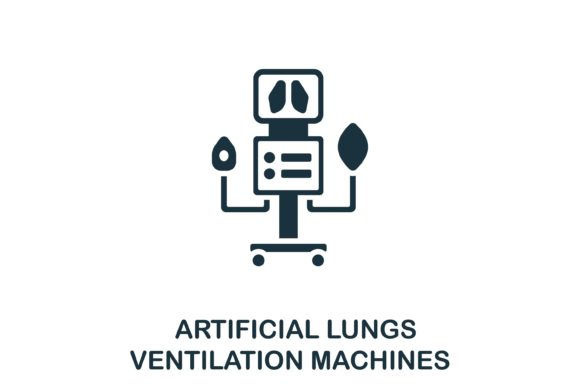
From a design perspective, the Artificial Lungs Ventilation Machines icon offers a simplified visual symbol for representing these devices in diagrams, user interfaces, and educational materials. Available in vector (EPS) and raster (JPG) formats, this icon supports a range of digital workflows, from website templates to printed infographics. Its monochrome style ensures flexibility across color schemes and backgrounds.
Using Artificial Lungs Ventilation Machines Across Workflows
In a medical setting, these machines are typically used during or after critical interventions. They may be deployed in emergency response, ICU care, or post-operative recovery. Their integration into hospital systems involves coordination with electronic health records (EHR), patient monitoring tools, and clinical decision support systems. This ensures that ventilation settings, patient vitals, and response metrics are logged and analyzed in real time.
For designers and educators, the Artificial Lungs Ventilation Machines icon can be embedded into dashboards, infographics, or training modules to represent ventilator support in medical scenarios. Whether you're building a patient education app or a hospital navigation system, incorporating consistent and recognizable icons improves usability and reduces cognitive load for end users.
Integration with Other Tools and Platforms
Medical-grade Artificial Lungs Ventilation Machines often interface with a range of tools including:
- Patient monitors
- Alarm systems
- Electronic medical records (EMR)
- Mobile clinical apps
These integrations allow for remote monitoring, automated alerts, and data-driven adjustments to ventilation settings. For example, a clinician using a tablet app connected to a ventilation machine can receive real-time updates on a patient's oxygen saturation and breathing rate, enabling faster, more informed decisions.
On the design side, the Artificial Lungs Ventilation Machines icon can be imported into graphic design software like Adobe Illustrator or Figma. Its vector format allows for scaling without loss of quality, making it suitable for both high-resolution print and responsive web layouts. Compatibility with common design tools means it can be easily customized or combined with other icons to build comprehensive visual systems.
Practical Implementation Tips
Whether you're implementing Artificial Lungs Ventilation Machines in a clinical environment or integrating their visual representation into a design project, preparation and compatibility are key. Here are some actionable tips to ensure smooth integration:
- Verify system requirements before connecting a ventilation machine to hospital networks or EMR systems.
- Standardize icon styles across your design project to maintain visual consistency. Use the Artificial Lungs Ventilation Machines icon alongside other medical symbols for a unified look.
- Test responsiveness when using the icon in web templates. Ensure it scales correctly across devices and remains legible at various sizes.
- Document usage guidelines for both the medical equipment and its visual counterpart. This helps maintain clarity and reduces errors in training or implementation phases.
When working with the icon, consider its placement in relation to text and other visual elements. A well-placed icon can serve as a visual anchor, improving readability and engagement in presentations or instructional materials.
Workflow Examples
Here are two real-world examples of how Artificial Lungs Ventilation Machines and their associated icon can be used within specific workflows:
- Clinical Use Case: An ICU nurse uses a ventilation machine connected to a central monitoring system. As patient data flows into the EMR, the nurse receives alerts on a mobile device, allowing for timely adjustments to ventilation settings. This integration streamlines patient care and documentation.
- Design Use Case: A health tech startup is building a patient education platform. The design team uses the Artificial Lungs Ventilation Machines icon to illustrate how ventilators support breathing in respiratory illness. The icon is placed next to explanatory text and animated diagrams, enhancing user understanding.
Both examples highlight how the device and its visual symbol contribute to clarity and efficiency within their respective domains.
Ensuring Long-Term Usability and Quality
Long-term use of Artificial Lungs Ventilation Machines requires ongoing maintenance, calibration, and staff training. Hospitals and clinics should establish regular service schedules and keep spare parts on hand to minimize downtime. Similarly, digital assets like the Artificial Lungs Ventilation Machines icon should be stored in a centralized media library for easy access and version control.
When using the icon in long-running projects or across multiple platforms, ensure it remains consistent in style and placement. Over time, small inconsistencies in visual assets can lead to confusion or a disjointed user experience. Periodic audits of design systems and clinical equipment performance help maintain quality and reliability.
Conclusion
Artificial Lungs Ventilation Machines are essential tools in modern healthcare, providing critical support for patients with compromised respiratory function. Their digital counterpart—the Artificial Lungs Ventilation Machines icon—offers a practical and adaptable visual representation for designers, educators, and developers. By integrating both the physical device and its visual symbol into broader workflows, professionals can enhance clarity, streamline communication, and improve outcomes across medical and creative fields.